

LoRa Communication for IoT Applications
1 Mei 2026
In the Wireless Network course at Universitas Brawijaya, students are challenged to explore how modern communication technologies can be applied to real-world problems. Under Dr. Kasyful Amron, S.t., M.sc. class, one team consisting of Akbar Fikri Abdillah, Ahmad Nafi Mubarok, Fatoni Murfid Syaafii, and Aldura Armanu Shaufa Imron took on the task of studying LoRa (Long Range) modulation technology, a cornerstone of low-power, wide-area networks (LPWAN) that enables Internet of Things (IoT) devices to communicate efficiently over long distances. Their project combined theoretical study with practical experimentation, resulting in valuable insights into how LoRa performs under different conditions.
LoRa is built on Chirp Spread Spectrum (CSS) modulation, a technique that spreads signals across a wide frequency band to resist noise and interference. Unlike Wi-Fi or Bluetooth, which prioritize high data rates over short distances, LoRa sacrifices speed in exchange for range and energy efficiency. This trade-off makes it ideal for IoT applications where devices must operate for years on battery power while still maintaining reliable communication. The students began by examining LoRa’s architecture, including the role of gateways and servers in LoRaWAN networks, and the mathematical principles behind chirp modulation and demodulation using Fast Fourier Transform (FFT).
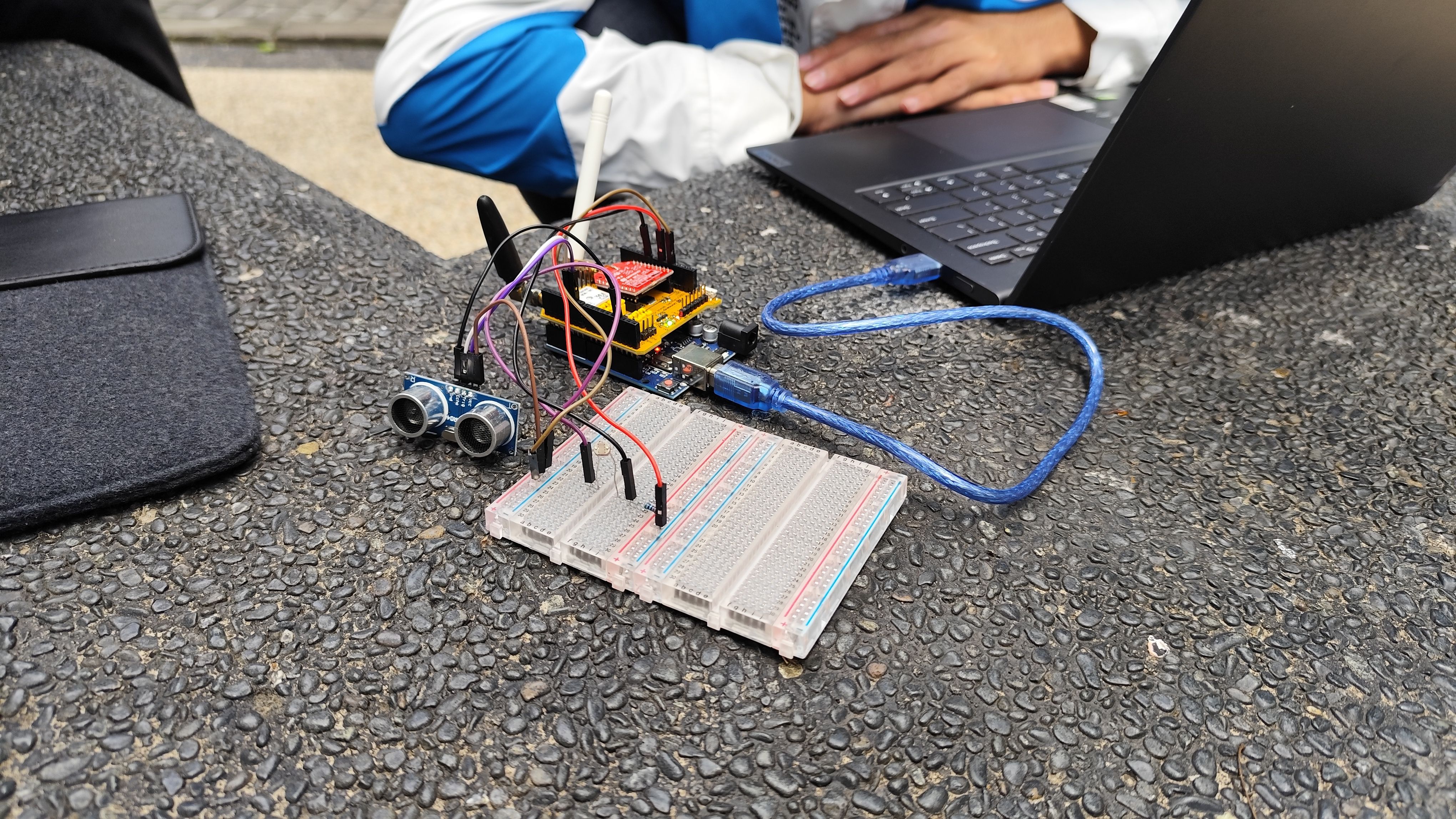
To put theory into practice, the team designed an experiment using Arduino UNO boards with Dragino LoRa Shields as end-nodes, paired with a Dragino LG01-N gateway. They equipped the nodes with sensors—an ultrasonic sensor to measure trash bin capacity and a light sensor to detect whether the bin was open or closed—creating a case study that simulated a smart waste monitoring system. The gateway collected data packets from the nodes and logged key parameters such as Received Signal Strength Indicator (RSSI) and Packet Delivery Ratio (PDR). This setup allowed the students to evaluate how distance and spreading factor (SF) influenced communication reliability.
Their experiments were conducted in the campus environment, which provided a realistic Non-Line-of-Sight (NLOS) scenario with buildings, vegetation, and uneven terrain. Testing was carried out at distances of 250 meters, 500 meters, and 750 meters, with spreading factors set to SF7, SF9, and SF12. The results revealed the classic trade-offs of LoRa communication:
- SF7 offered the fastest transmission but struggled beyond short distances.
- SF9 provided moderate reliability, with some packet loss at 500 meters.
- SF12 achieved the most stable communication at longer ranges, though at the cost of significantly higher transmission times.
At 750 meters, however, communication failed entirely, highlighting the limits of single-channel gateways in challenging urban environments. The students also observed how RSSI values declined with distance, confirming the expected weakening of signals over longer paths.
Through this project, the team gained a deeper understanding of how LoRa parameters—spreading factor, bandwidth, and coding rate—interact to shape performance. They demonstrated that while LoRa can deliver reliable communication in medium-range scenarios, careful tuning of parameters is essential to balance speed, reliability, and energy efficiency. Their smart waste monitoring prototype served as a practical example of how LoRa could be applied to urban IoT systems, offering a low-cost and low-power alternative to traditional wireless solutions.
More than just an experiment, this project showcased the students’ ability to connect theory with practice. By designing, implementing, and analyzing a LoRa-based communication system, they not only mastered the technical aspects of wireless networking but also created a foundation for future IoT applications in smart cities, environmental monitoring, and infrastructure management.
GitHub link: https://github.com/Lab-ICN/project-jarnir-lora-wan