



Exploring Bluetooth Communication with ESP32 and Android
1 Mei 2026
In the Wireless Network course at Universitas Brawijaya, students are encouraged to bridge theory with practice by building systems that demonstrate the principles of modern wireless communication. Under Dr. Kasyful Amron, S.t., M.sc. class, one team consisting of Brandon Geraldo Adji, Darvesh Aziz Mawla, and Joshua Washington Hutasoit took on the challenge of exploring Bluetooth technology, focusing on how short-range wireless communication can be harnessed for reliable data exchange between devices. Their project combined the ESP32 microcontroller with a custom Android application, resulting in a hands-on demonstration of Bluetooth Low Energy (BLE) communication.
Bluetooth has long been a cornerstone of everyday connectivity, powering headphones, keyboards, and countless smart devices. Operating in the 2.4 GHz ISM band, it uses Frequency Hopping Spread Spectrum (FHSS) to minimize interference and ensure secure communication. The students began by studying Bluetooth’s layered architecture—from the radio layer that manages signal transmission, to the baseband and link management protocols that handle pairing, authentication, and encryption. This theoretical foundation gave them the tools to design a system that could not only connect devices but also measure and analyze the quality of those connections.
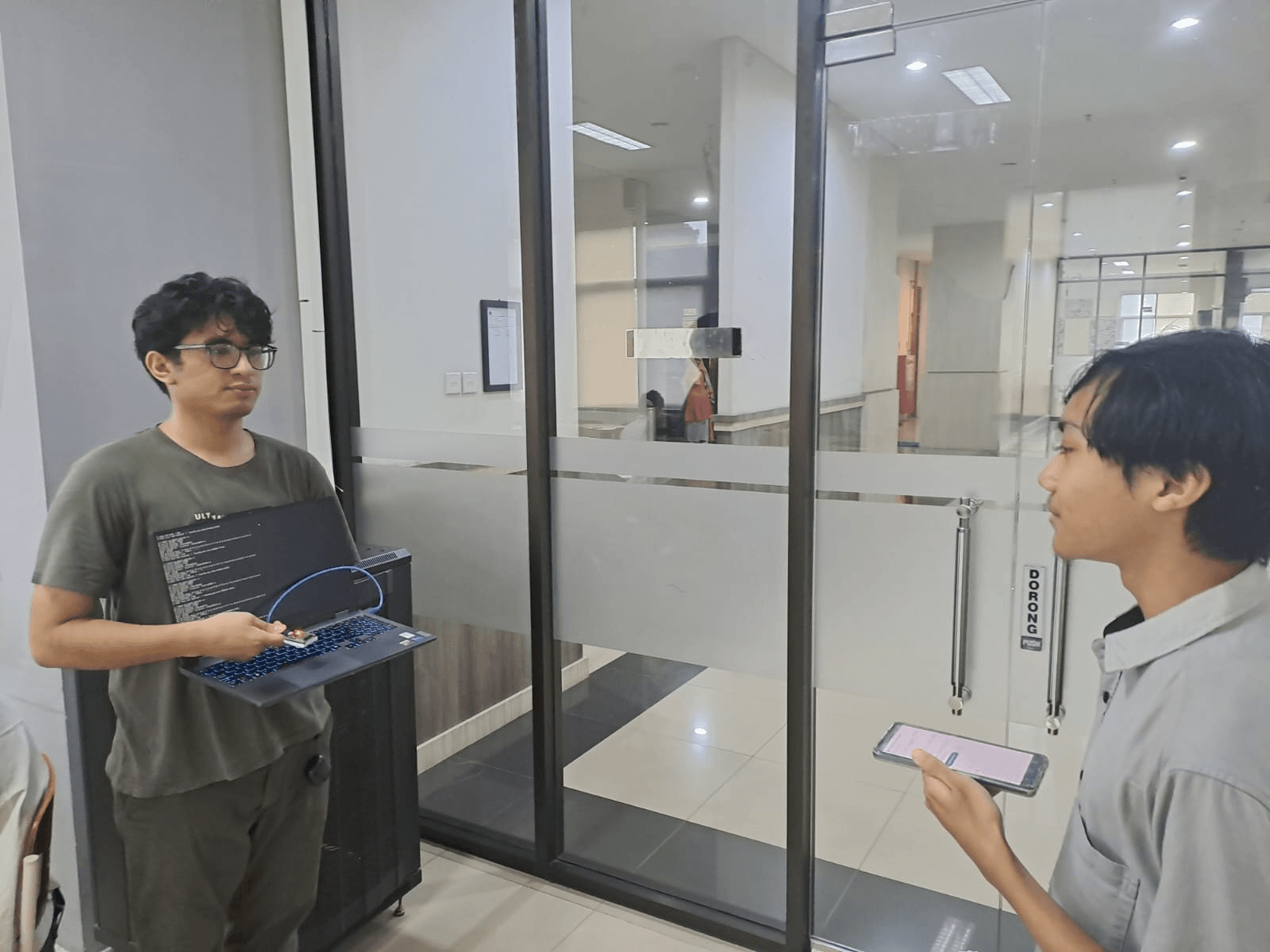
At the heart of their prototype was the ESP32-WROOM-32, a versatile microcontroller equipped with integrated Wi-Fi and Bluetooth. Using Arduino code, the students configured the ESP32 to act as a Bluetooth scanner, capable of detecting advertising packets broadcast by nearby devices. To complement this, they developed an Android application in Kotlin using Jetpack Compose. The app functioned as a BLE advertiser, periodically transmitting custom payloads containing counters and timestamps. This setup allowed the ESP32 to capture and log data such as signal strength (RSSI), transmission power, and latency between sender and receiver.
The experiments revealed the nuances of Bluetooth communication. By adjusting parameters like advertise mode (low power, balanced, or low latency) and transmit power level (ultra-low to high), the students observed how performance shifted between energy efficiency and responsiveness. Their logs showed differences in packet reception, timing accuracy, and signal strength, providing valuable insights into how BLE behaves under varying conditions. The ESP32’s LED indicator, blinking with each detected packet, became a simple but effective visualization of the system’s operation.
What makes this project significant is not just the technical implementation, but the way it connects classroom theory to real-world applications. The students demonstrated how Bluetooth’s principles—secure pairing, frequency hopping, and low-energy design—translate into practical systems for IoT and personal devices. Their Android app and ESP32 prototype together formed a complete communication loop, showcasing the reliability and adaptability of BLE in short-range scenarios.
Ultimately, the project highlighted the students’ ability to integrate hardware and software, design experiments, and analyze wireless performance. It also underscored Bluetooth’s continuing relevance as a technology that balances convenience, security, and efficiency. By building this system, the team not only deepened their understanding of wireless networking but also created a foundation for future projects in IoT, smart devices, and embedded systems.
GitHub link: https://github.com/Lab-ICN/project-jarnir-bluetooth