



Building a Wireless Alarm System with LoRa Point-to-Point
1 Mei 2026
In the Wireless Network course at Universitas Brawijaya, a group of Informatics students set out to explore how theory could be transformed into practice. Their challenge was to take the concepts of wireless modulation and apply them to a real-world system. Under Dr. Kasyful Amron, S.t., M.sc. class, I Putu Natha Kusuma, Komang David Dananjaya Suartana, Putu Indah Githa Cahyani, and Sayyidah Fatimah Azzahra built a working prototype of a LoRa Point-to-Point alarm system, built on the ESP32 microcontroller, that showcased both technical skill and creative problem-solving.
LoRa, short for Long Range, is a modulation technique based on Chirp Spread Spectrum (CSS). It is designed to transmit data over long distances while consuming very little power, making it a cornerstone of modern IoT applications. Unlike LoRaWAN, which requires gateways and centralized servers, LoRa Point-to-Point allows two devices to communicate directly. This simplicity makes it ideal for applications such as alarms, monitoring, and remote control—precisely the kind of system the students envisioned.
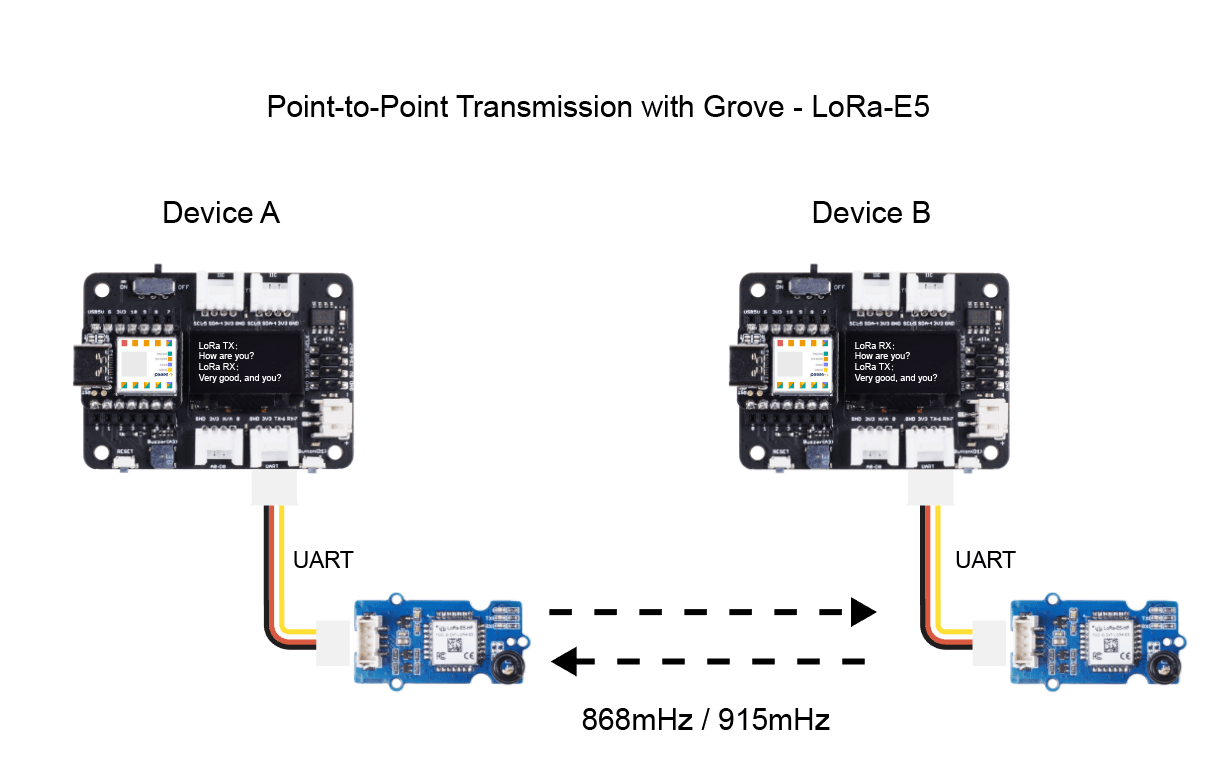
Their prototype consisted of two ESP32 boards, each paired with a LoRa RA-02 SX1278 module operating at 433 MHz. One board acted as the transmitter, equipped with a push button to trigger the alarm signal. The other served as the receiver, programmed to activate a buzzer and LED whenever the signal was received. With this setup, the students could test how different LoRa parameters—spreading factor, bandwidth, and coding rate—affected the reliability and speed of communication.
The project was not just about assembling hardware. It was an experiment in understanding how wireless signals behave in real environments. The students conducted tests both in the lab and outdoors, measuring indicators such as Received Signal Strength (RSSI), Signal-to-Noise Ratio (SNR), and frequency error. They experimented with different distances and conditions, including line-of-sight scenarios and environments with obstacles that introduced multipath fading. These experiments revealed the trade-offs inherent in LoRa communication: higher spreading factors improved signal robustness but slowed data rates, while narrower bandwidths increased sensitivity at the cost of speed.
Through careful tuning, the team settled on a configuration that balanced efficiency and reliability: SF7, BW 125 kHz, CR 4/5, and transmit power at +17 dBm. This allowed their system to transmit alarm signals across several hundred meters with consistent performance, proving that LoRa could deliver stable communication without excessive energy consumption.
Beyond the technical results, the project carried broader significance. It gave the students a chance to apply classroom knowledge to a tangible system, bridging theory and practice. It also highlighted LoRa’s potential as a cost-effective alternative to WiFi or cellular networks for long-range communication. Their prototype, though simple, could serve as the foundation for more advanced applications in security, monitoring, and IoT development.
In the end, the project was more than just a course requirement. It was a demonstration of how curiosity, experimentation, and teamwork can turn abstract concepts into working technology. By building a LoRa-based alarm system, the students not only showcased their mastery of wireless networking principles but also contributed to the growing body of practical applications for low-power, long-range communication.
GitHub link: https://github.com/Lab-ICN/project-jarnir-lora-p2p