



Transpubin: Revitalizing Public Transportation Through IoT-Based Monitoring and Smart Systems
1 Mei 2026
Developed by members of the Information-Centric Networking (ICN) Laboratory under the supervision of Dr. Kasyful Amron, S.T., M.Sc., Transpubin is an Internet of Things (IoT)-based system proposed for the Smart City division of the Gemastik national competition. The project addresses long-standing challenges in traditional public transportation (Angkot) in Malang, including declining ridership, lack of operational transparency, unpredictable schedules, and minimal regulatory oversight. Rather than replacing the system entirely, Transpubin introduces a digital infrastructure layer aimed at improving visibility, accountability, and overall service quality.
At the core of the system is an ESP32-based node installed in each vehicle, designed to collect and transmit operational data in real time. The node integrates a NEO-6M GPS module for location tracking and an MFRC-522 RFID sensor to support both passenger identification and occupancy monitoring. Communication between the node and backend server is facilitated by GSM modules from the SIM800 series, enabling data transmission over cellular networks. MQTT is utilized for lightweight, continuous telemetry, while HTTP/HTTPS is employed for transactional processes such as payment handling, ensuring a balance between efficiency and reliability.
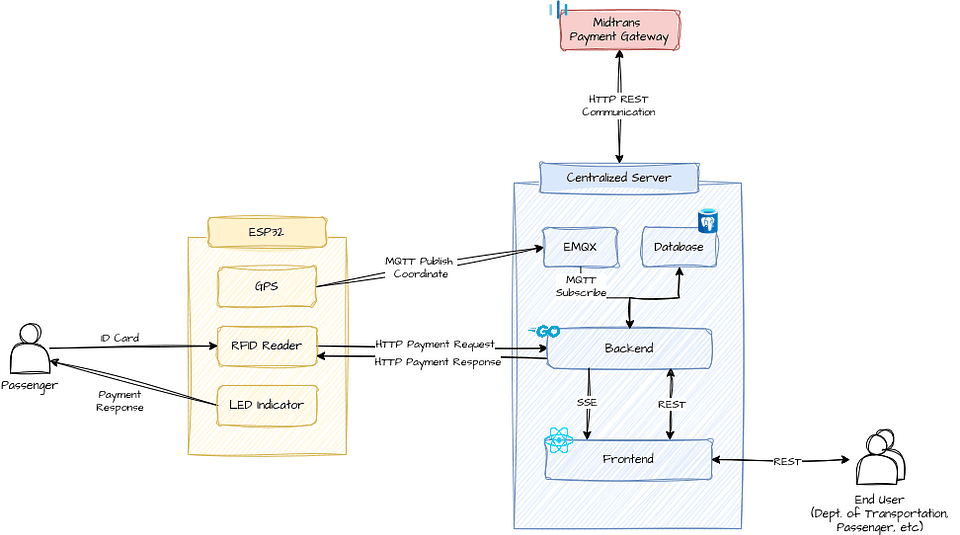
The backend system acts as a central data processor and communication hub, subscribing to MQTT topics through a broker (HiveMQ) and handling incoming data streams from multiple nodes. Real-time tracking is achieved by distributing processed data to client applications using Server-Sent Events (SSE), allowing continuous updates without the overhead of bidirectional communication protocols. Location data is further utilized for analytical purposes, including vehicle speed estimation. This is computed by measuring the distance between consecutive GPS coordinates using the Haversine formula and dividing it by the corresponding time interval, enabling the system to approximate vehicle velocity in real-world conditions.
To address the issue of passenger uncertainty and fleet monitoring, the system incorporates an RFID-based mechanism for tracking occupancy. Passengers interact with the system by tapping a registered card when entering and exiting the vehicle. The backend maintains a dynamic record of active passengers by adding or removing identifiers based on these interactions, allowing real-time estimation of passenger count. Although initial plans involved leveraging national identification cards for seamless integration, encryption constraints required the system to rely on pre-registered card identifiers instead, introducing an additional layer of system design consideration.
Throughout the development process, the team encountered several practical challenges that underscored the gap between theoretical design and real-world implementation. GPS modules demonstrated limited accuracy in obstructed environments, requiring open-sky conditions for reliable signal acquisition. Similarly, GSM connectivity proved inconsistent due to reliance on legacy 2G infrastructure, resulting in intermittent data transmission and latency issues. These constraints highlighted the importance of hardware selection, environmental awareness, and system robustness when designing IoT solutions for urban deployment.
Despite these limitations, the prototype successfully demonstrated the feasibility of integrating real-time tracking, passenger monitoring, and communication systems into a unified platform. The system provides a foundational framework that can be extended to support more advanced features, such as route optimization, adaptive traffic control based on real-time data, and large-scale transportation analytics. By introducing a data-driven approach to a traditionally informal system, Transpubin presents a scalable and cost-effective pathway for improving public transportation services.
Ultimately, Transpubin reflects an approach to technological innovation that emphasizes augmentation rather than replacement. By embedding digital intelligence into an existing transportation system, the project illustrates how IoT technologies can be leveraged to enhance functionality, improve user experience, and support smarter urban mobility solutions within the context of developing cities.
GitHub link: https://github.com/AngkutIn-Gelatik