



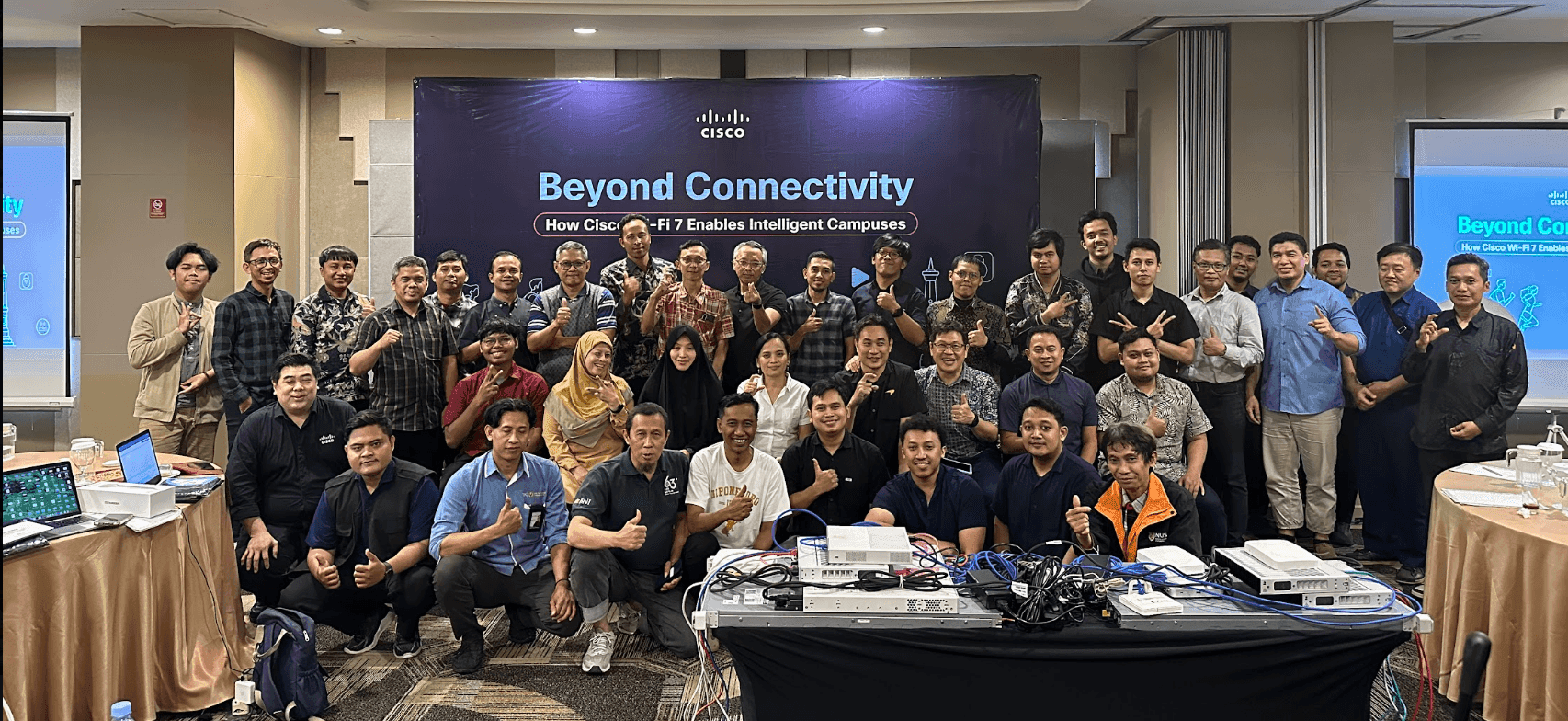
Beyond Connectivity: Exploring Cisco Wi-Fi 7 for Intelligent Campus Networks
8 Maret 2026 • ~3 min read
From February 10 to 12, 2026, networking practitioners, students, and technology enthusiasts gathered at The Alana Malioboro Hotel in Yogyakarta for a technical session titled “Beyond Connectivity: How Cisco Wi-Fi 7 Enables Intelligent Campuses.” The event introduced the latest advancements in wireless networking, focusing on how Wi-Fi 7 technology can support scalable campus connectivity, intelligent infrastructure, and future-ready wireless experiences.
FIRST DAY
Tuesday, February 10, with participant arrivals and room allocation at the hotel lobby. In the evening, attendees joined a networking dinner at Prawiro Resto, providing an opportunity for participants to meet each other and exchange insights before the technical sessions began. Although the first day was relatively relaxed, it set the stage for collaboration and discussions among professionals and students interested in next-generation wireless networking.
Second Day
The main technical sessions took place on Wednesday, February 11, beginning with registration and an opening speech before moving into the core presentations. The first session introduced the key features and use cases of Wi-Fi 7 (802.11be), the newest generation of wireless technology designed to deliver significantly higher performance compared to Wi-Fi 6E. The speakers highlighted that Wi-Fi 7 can achieve up to three times higher throughput, making it well suited for high-density environments such as university campuses and research facilities.
Several core technologies behind Wi-Fi 7 were discussed, including support for 320 MHz channels in the 6 GHz band, 4K QAM modulation, and Multi-Link Operation (MLO). With MLO, client devices are able to connect to multiple frequency bands simultaneously, improving both network speed and stability. The session also emphasized the importance of WPA3 security, which becomes a key requirement in modern wireless deployments to protect networks from attacks such as unauthorized deauthentication attempts.
The second session focused on Cisco’s unique differentiators in their wireless ecosystem, particularly in terms of monitoring and intelligent infrastructure. Cisco access points integrate multiple radios in a single device, including radios for the 2.4 GHz, 5 GHz, and 6 GHz bands, along with an additional monitoring radio often referred to as a listener. This dedicated radio continuously scans the surrounding spectrum to detect interference from unknown sources such as microwaves, surveillance devices, or other non-Wi-Fi transmitters. Using technologies like CleanAir, the system can analyze these signals and help prevent potential interference or jamming within the wireless environment.
Another interesting capability highlighted during the session was the concept of Access Points functioning as sensors. Modern Cisco APs are able to observe their surrounding environment, detect connected devices, and even track their location within a network area. This capability opens various practical use cases, such as asset tracking, environmental monitoring, and smart campus services. In educational environments, for example, the network infrastructure could potentially detect student devices when they enter a classroom and automatically record attendance, demonstrating how wireless infrastructure can evolve into part of a broader IoT ecosystem.
In addition to presentations, participants also had the opportunity to explore a short hands-on demonstration session. During this demo lab, attendees observed how Cisco wireless infrastructure can be managed through both cloud-based and on-premises platforms. This hybrid management model allows organizations to operate large-scale campus networks efficiently while maintaining centralized visibility and control.
Third Day
The final day of the event, Thursday, February 12, began with a refreshing fun run around the Yogyakarta Royal Palace area. Participants gathered early in the morning at the hotel lobby before starting the run together. Beyond being a recreational activity, the session provided another opportunity for attendees to interact and strengthen professional connections in a more informal environment. The event concluded with a networking breakfast at Prawiro Resto before participants headed back to their cities.
Overall, the Beyond Connectivity event offered valuable insights into the future of wireless networking. By combining theoretical discussions, real-world deployment strategies, and interactive sessions, the program demonstrated how Wi-Fi 7 technology will play a critical role in building intelligent and future-ready campus networks. For participants, the experience was not only an opportunity to learn about emerging wireless technologies but also to connect with professionals who share a common interest in advancing network infrastructure for the next generation of digital environments.
Written by
Nizar Maulana Wahyudi
Signed on
2026-03-08