



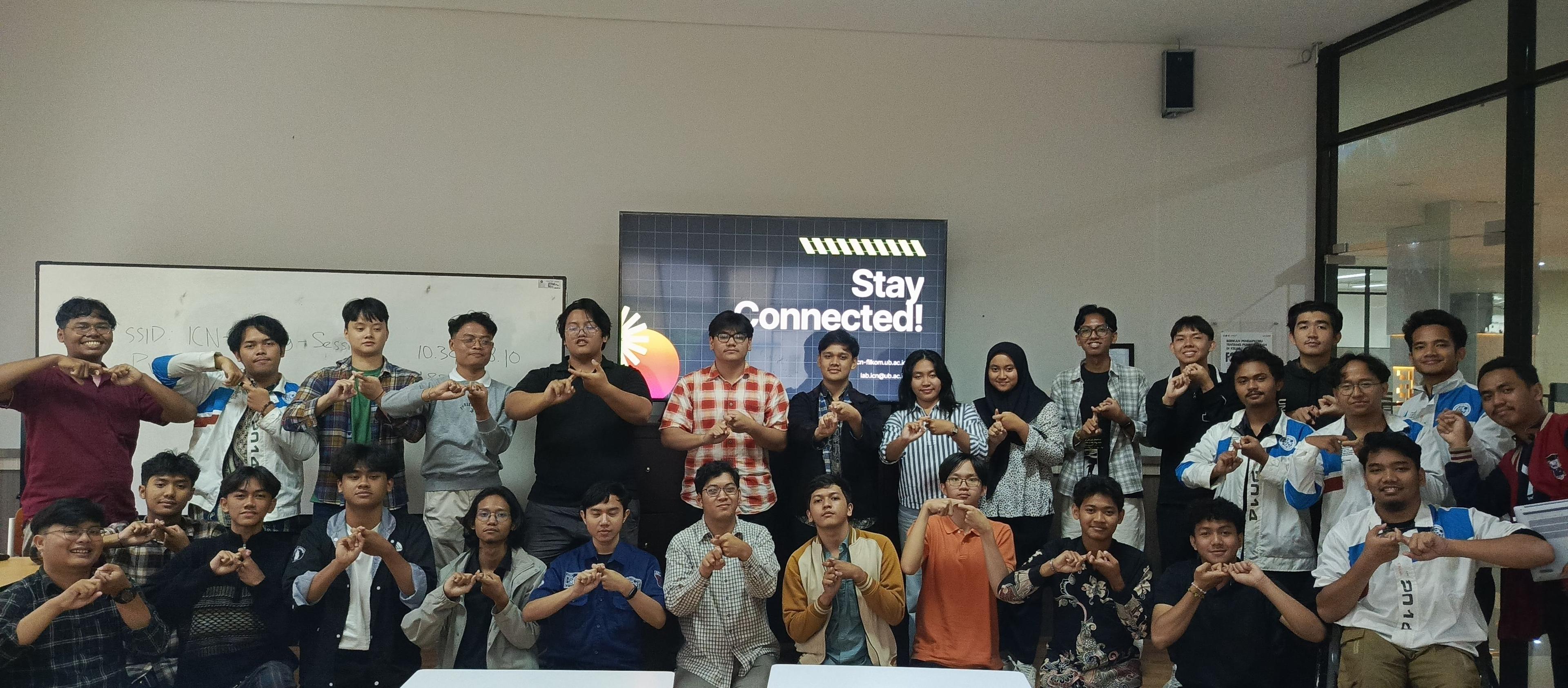
ICN Lab Sharing Session IoT Basic 2025
14 November 2025 • ~2 min read
In today’s digital era, the Internet of Things (IoT) has become deeply embedded across countless sectors. For students in the Faculty of Computer Science, understanding IoT—at least at a foundational level—has become essential. Yet, many first-semester students rarely encounter hands-on IoT implementation early in their studies. Addressing this gap, the Information Centric Networking (ICN) Laboratory held a sharing session dedicated to introducing IoT both conceptually and practically.
The session opened with a theoretical overview delivered by Ahmad Nafi, one of the Lab’s members. He began with the fundamental definition of IoT: everyday objects connected through the internet, capable of exchanging data seamlessly. Nafi walked participants through how these devices communicate, the flow of data, and the basic architecture underpinning IoT systems. Once the participants had a firm grasp of the fundamentals, the discussion moved toward sensors and actuators, focusing on two main sensors used in the workshop: the DHT (Digital Humidity and Temperature) sensor and an Ultrasonic sensor.
Before moving into the hands-on segment, Nafi demonstrated how the DHT sensor reads humidity and temperature data. Participants were then given ESP32 development boards equipped with the necessary components. Their first task was to connect the sensors using jumper wires and read temperature-humidity data, triggering a buzzer whenever readings exceeded a given threshold. Nearly all groups succeeded, resulting in the room echoing with a lively “buzzer orchestra.”
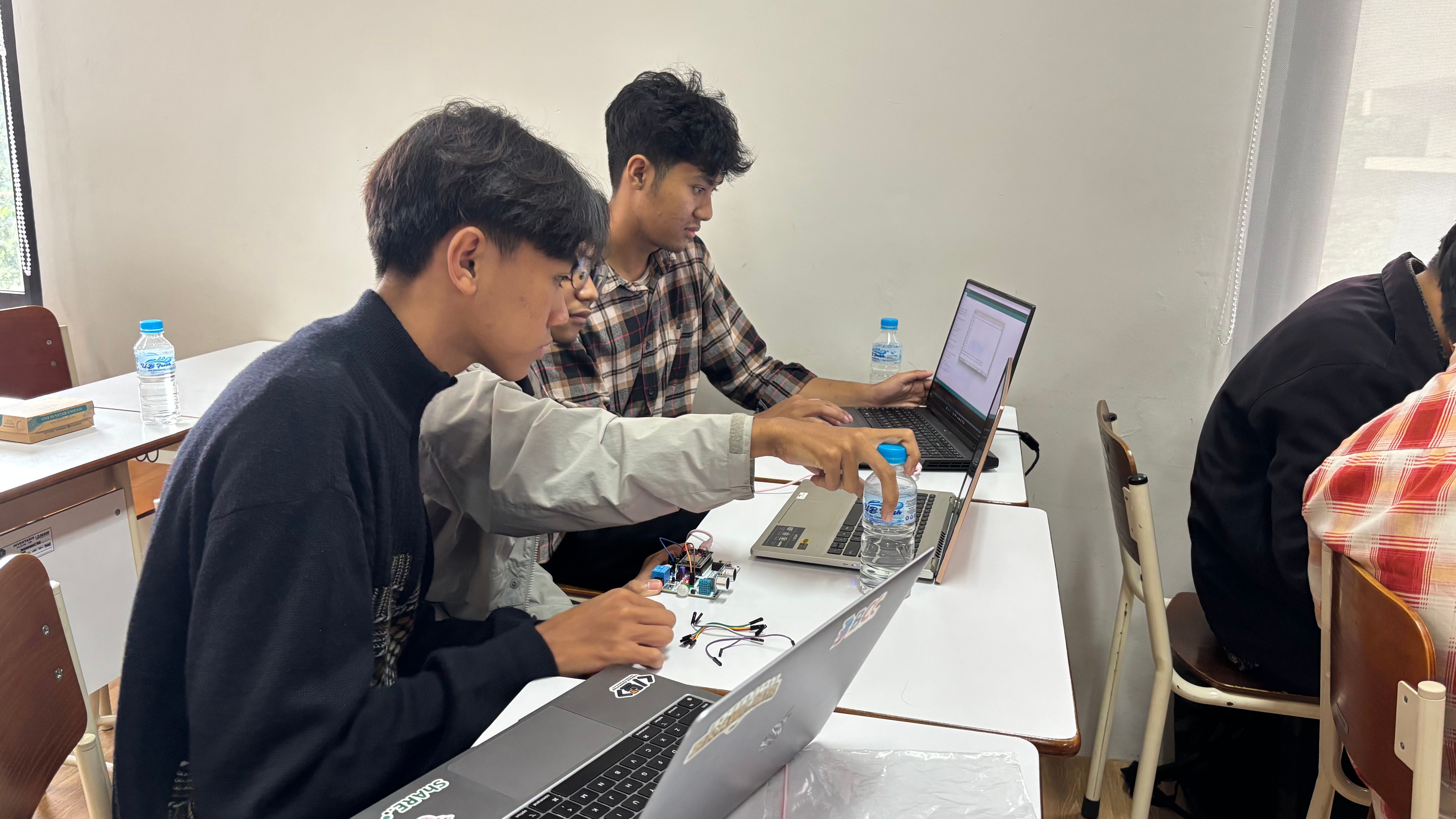
After completing the first challenge, participants were introduced to MQTT brokers and how IoT nodes send data to a centralized server over the internet. They also explored Node-RED, a simple yet powerful tool for visualizing MQTT data flows. Once everyone successfully connected their IoT nodes to the internet, the workshop moved to the second sensor. This time, Nizar Maulana, another Lab member, introduced the Ultrasonic sensor, explaining its basic working principles. Participants repeated a similar process: reading data, publishing it to the MQTT broker, and visualizing the output through Node-RED.
To conclude the session, participants were encouraged to propose a real-world problem they believed could be solved using IoT technology. This final activity not only sparked creativity but also emphasized the practical relevance of IoT in everyday life. The event marked the final ICN Lab sharing session of the year, a fitting close to a series dedicated to expanding students’ hands-on understanding of emerging technologies.
Written by
Raditya Nala
Signed on
2025-11-14