



IoT System Implementation Training Using Bluino Development Board for Vocational High School Students
19 Oktober 2025 • ~4 min read
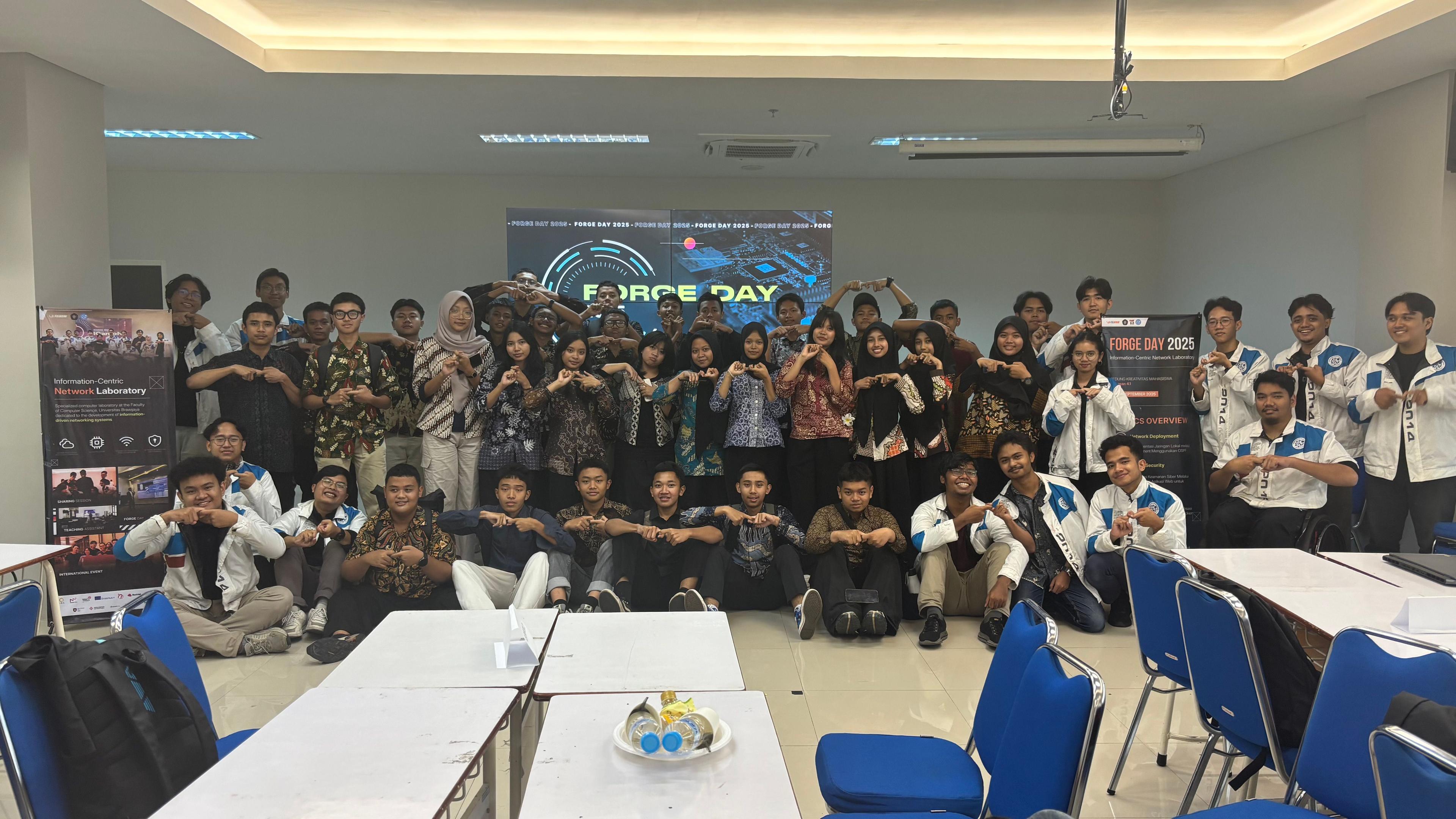
MALANG, EAST JAVA – The Information Centric Networking Laboratory at Brawijaya University's Faculty of Computer Science recently conducted a comprehensive community service initiative aimed at bridging the gap between emerging technology and vocational education. The event, titled "IoT System Implementation Training Using Bluino Development Board for Vocational High School Students," brought together approximately 50 students from SMK Telkom Malang for an intensive introduction to Internet of Things (IoT) systems.
Addressing the IoT Knowledge Gap
The training program was born from a recognition that while IoT has become integral to modern life—spanning agriculture, smart cities, and home automation—much of its potential remains underutilized due to limited understanding and accessibility. The initiative aimed to introduce fundamental IoT concepts to vocational students early in their education, preparing them for future industrial requirements.
"Many people think IoT is as simple as a node reading and doing something with data, but they fail to understand the role of the internet in these systems," explained Yoga Raditya, a Brawijaya University student who presented the opening material. "That's why we need to start with proper definitions to prevent misconceptions from the beginning."
Six Months of Planning Pays Off
The event was coordinated by three Brawijaya University lecturers—Widhi Yahya, Reza Andria Siregar, and Nur Hazbiy Shaffan—who began planning six months in advance. The program combined theoretical presentations with comprehensive educational modules and hands-on training sessions, ensuring participants gained both conceptual understanding and practical skills.
Each participating group received a Bluino Development Board equipped with ESP32 microcontrollers, multiple sensors, and actuators for use throughout the training. The structured approach included pre-tests and post-tests to measure learning outcomes.
From Theory to Practice
The training covered essential IoT building blocks, starting with fundamental concepts of interconnected devices and the MQTT protocol—a communication standard that enables devices to exchange information. Instructors used relatable analogies, such as comparing MQTT brokers to group chats where publishers send messages and subscribers receive them, making complex concepts accessible to high school students.
Participants were also introduced to Node-RED, a visualization tool that allows users to monitor IoT data through charts, gauges, and dashboards accessible from any device. This web-based platform enabled students to see their IoT systems in action without needing to master complex programming logic.
The hands-on sessions, led by students Ahmad Nafi and Nizar Maulana, guided participants through real-world applications. Students learned to use DHT sensors to measure temperature and humidity, programming their systems to trigger alarms when thresholds were exceeded. They also worked with ultrasonic sensors for distance detection, building complete end-to-end IoT systems that integrated sensors, actuators, and cloud-based visualization.
Measurable Impact
The training's effectiveness was evident in the assessment results. Participants' average scores improved significantly from 55.60 in the pre-test to 71.60 in the post-test, demonstrating substantial knowledge gains. While time constraints prevented some students from completing all exercises, the majority successfully implemented functioning IoT systems by the program's conclusion.
"This event demonstrated the importance of early exposure to emerging technologies," organizers noted. "By introducing these concepts at the vocational high school level, we're fostering innovation and preparing younger generations to meet future industrial demands."
Building Future-Ready Skills
The initiative addresses a critical need in Indonesia's technology education landscape. As industries increasingly rely on IoT solutions for automation and data-driven decision-making, vocational students equipped with these skills will be better positioned for careers in technology sectors.
The success of this program highlights the value of university-community partnerships in democratizing access to cutting-edge technology education. By providing infrastructure, equipment, and expert instruction, Brawijaya University has created a replicable model for introducing complex technical concepts to younger students in ways that are both accessible and engaging.
As IoT continues to transform industries worldwide, initiatives like this ensure that Indonesia's next generation of technical professionals will be prepared to not just use these technologies, but to innovate and expand their applications in meaningful ways.
Written by
Raditya Nala
Signed on
2025-10-19