



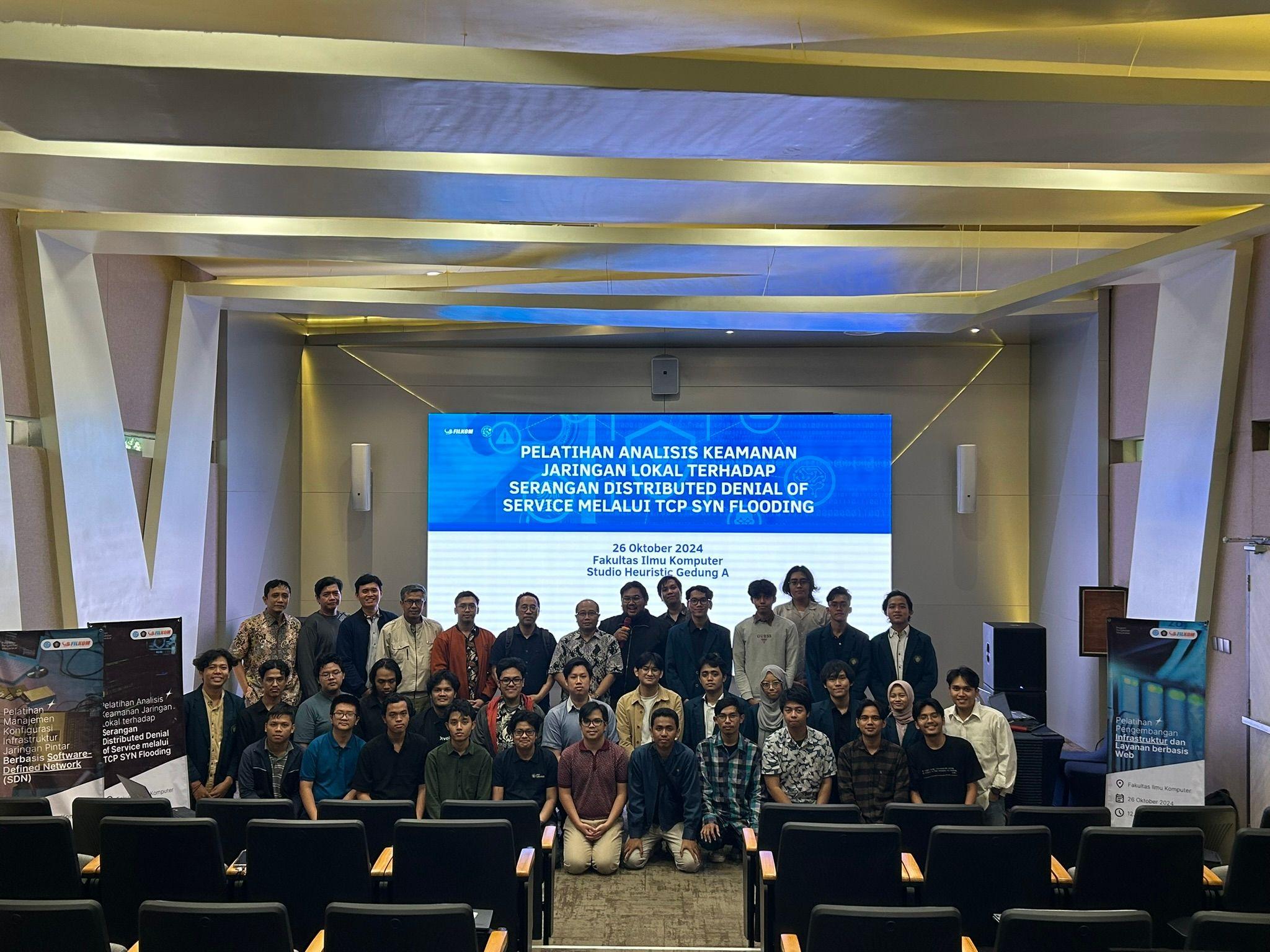
Training on Local Network Security Analysis Against Distributed Denial of Service Attack via TCP SYN Flooding
26 Oktober 2024 • ~5 min read
This training aims to provide participants with a fundamental understanding of Denial-of-Service (DoS) and Distributed Denial-of-Service (DDoS) attacks, specifically TCP SYN flooding, and mitigation strategies using IPTables for network traffic management.
Training Modules
1. Denial-of-Service (DoS) and Distributed Denial-of-Service (DDoS)
Learn the basic concepts and technical aspects of DoS and DDoS attacks, a prevalent cybersecurity threat in modern technology.
2. TCP Protocol and Three-Way Handshake
Understand the Transmission Control Protocol (TCP) and its Three-Way Handshake process involving SYN, SYN-ACK, and ACK packets.
3. TCP SYN Flood
Study the mechanics of TCP SYN Flood attacks, their impact, use cases, and tools commonly employed in such attacks.
4. TCP SYN Flood Tools and Attack Demonstration
Explore tools like hping3 and LOIC for executing TCP SYN Flood attacks, with demonstrations using two virtual machines and detection via resource monitoring tools like btop.
5. Mitigation Using IPTables
Learn to use IPTables as a firewall tool to mitigate TCP SYN Flood attacks, including key components like Tables, Chains, Rules, and Targets.
Training Objectives
By the end of this training, participants will:
- Gain a conceptual and technical understanding of DoS and DDoS attacks.
- Comprehend the TCP protocol, Three-Way Handshake, and SYN Flood vulnerabilities.
- Learn TCP SYN Flood attack techniques, detection, and monitoring tools.
- Apply IPTables for effective attack mitigation.
Training Methods
The training combines theoretical sessions and hands-on demonstrations with real-world case studies, simulating attacks and mitigation techniques. Participants will also discuss current cybersecurity issues.
Sessions are delivered by Ahmad Nabih Baril Hilmy, I Gusti Ngurah Ryo Aditarta, and Tiara Calista Kusumawardani Atarian.
Signed on
2024-10-26